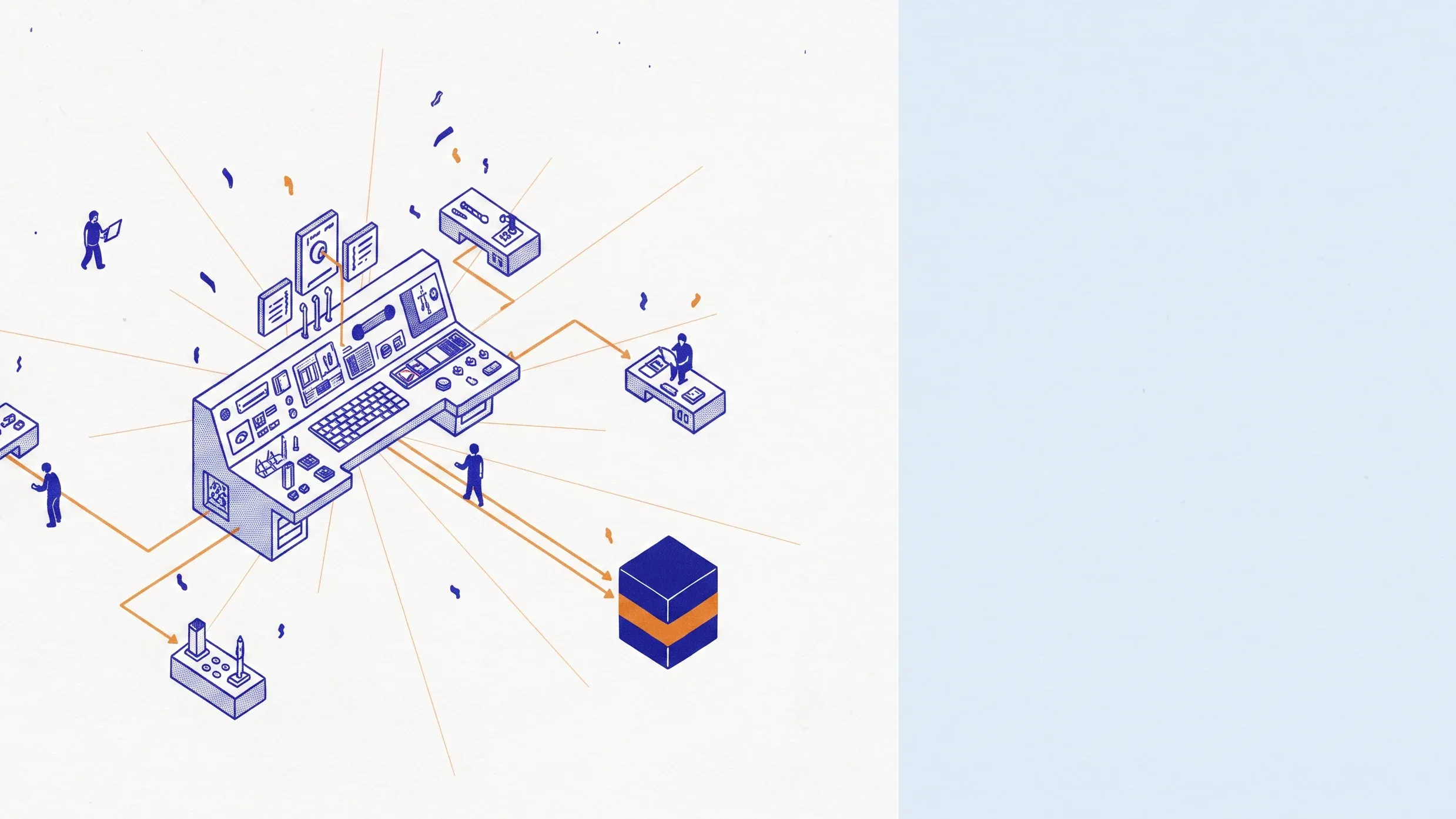
Most of my own work now happens in a terminal window. I describe what I want, an agent does the work between the idea and the result, and I read what comes back. The agent isn't limited to code. More and more, it manages the services we pay for directly, without me opening any of them. A growing number of people run their companies this way, and it stopped being a developer habit a while ago. If you don't work in a terminal, the same thing is happening inside the automation stack, or the assistant in whatever tool your team already runs.
After enough months of working like this, one thing stood out. The agent knew everything about the tools and nothing about the brand.
It could reach every service we paid for. What it couldn't reach was the one thing all of that work depended on: who we are, how we sound, what we're allowed to claim, which customer we're talking to. That lived in a document I pasted in when I remembered to, and in my head the rest of the time. Every session the agent started from zero on the brand, and every session I re-briefed it, badly, in a hurry, from memory.
The agent knew everything about the tools and nothing about the brand.
| What the agent could reach | What it couldn't | |
|---|---|---|
| In the room where the work happens | Every service we paid for. It manages them directly, without me opening any of them. | Who we are, how we sound, what we're allowed to claim, which customer we're talking to. That lived in a document I pasted in when I remembered to, and in my head the rest of the time. |
I've written before about software's next buyer, the agent that evaluates and purchases without eyes. This piece is about the agent that works. The next hire at most consumer brands isn't going to be a person. It's going to be one of these, and it will show up with no onboarding at all.
What a person gets on their first day
The math on bringing a human into a brand is in another piece: ten to twenty hours at a minimum, realistically closer to a hundred, before I trust someone with the voice and the facts, let alone with how I want the brand operated. The large-company version of that number comes from a survey of a thousand U.S. workers at organizations with at least two hundred employees: the average new hire gets two and a half months of formal training, and it can still take up to six months to actually ramp up (Panopto Workplace Knowledge and Productivity Report, with YouGov, 2018). That survey stops at companies of two hundred people, so for a small brand it's an analogy, not a measurement. Big companies, with budgets for training, still wait half a year before a person is fully useful.
Nobody gives an agent half a year. Nobody gives it a hundred hours. It gets a paste, or a prompt that says "understand my brand," and then it gets asked to write the launch email. It can do a passing job on that. Why the passing job falls apart when you push it is the subject of the product's own introduction. This piece is about the room the agent works in.
Nobody gives an agent half a year. Nobody gives it a hundred hours.
The room is the terminal, or the automation stack, or wherever the agent lives, and for the brand to exist in that room the agent has to be able to ask it questions and get the brand's own answers, the same way it asks the email platform to send or the ad platform for yesterday's numbers. In plain terms, the brand has to be callable. In technical terms, it needs an API and an MCP server, MCP being the shared standard agents use to plug into a service, so those are the two doors agents already know how to walk through. A brand book can't be called, and neither can a Notion page. A person can, and that's the problem, because the person is me, and I'm the most expensive thing in the building to interrupt.
The agent asks it to send, and it sends. A connection the agent already knows how to make, without anyone setting it up again.
The agent asks it for yesterday's numbers and gets them back. The same kind of connection, made the same way.
The agent asks it a question and gets the brand's own answer. The same kind of connection as the other two, and not a special one.
I learned what it means for a brand to live in a person when a partner left one of my businesses, on good terms, and a big portion of the knowledge left with them, a story that belongs to The Context No Hire Can Carry. What I took from it into this product is narrower. The record has to sit somewhere a new hand can read from on its own, and the new hand, more and more often, is an agent.
A teammate, with a teammate's permissions
I think of AI just like any other teammate. That sounds like a soft line, and it turns out to carry the hardest rule in the product, because of what it implies about permissions. You don't hand a new teammate the company card on day one. You don't give them the password to the brand's social accounts, or put them on the phone with a customer who's angry. They earn each of those, and in my experience they earn them in exactly two ways.
You don't hand a new teammate the company card on day one.
The first is understanding the process. A person who knows how a piece of work gets made, why the claim was pulled, why the email to a customer who already bought reads differently from the ad, can be trusted with more of it. The second is results over time, where consistency is the evidence: somebody who has delivered on-brand work again and again gets a longer leash than somebody who delivered it once, however good the once was.
Knows how a piece of work gets made, why the claim was pulled, why the email to a customer who already bought reads differently from the ad.
Has delivered on-brand work again and again, which earns a longer leash than delivering it once, however good the once was.
An agent is no different, and most of what we built at Jinn follows from taking that seriously. The chain gets verified at several points along the way and never just once at the end. There are human stop points and approvals, on purpose, and a transparency layer heavy enough that you can see what the agent read and what it did with it. The system is also willing to say "we can't do that," or to flag a risk back to you, when the alternative is delivering something that isn't authentic or isn't in your interest. The ladder an AI staff climbs, from off, to surfacing its work, to acting on its own, has a piece of its own; this is the founder's version of why the ladder exists.
The clearest place to see the principle is the door we built for agents. An agent connected to a brand's record through Jinn can read a great deal. Of everything it can call, exactly two things write, and neither one can complete a payment. One can queue a purchase and hand you a link. The other can file a document for you to approve. There's no setting that changes it; the door was built that way. A person completes the checkout, and a person approves the fact.
The slop wave
You've seen the other version: a video made in one shot that looks terrible, or a product render with a label that says the wrong thing, sitting in a feed next to real work. I've started calling it the AI slop wave, and what it argues against is handing a tool full autonomy on day one.
One-shotted work is what you get from a teammate who was never onboarded and never checked. It didn't understand the process and it had no track record, so it had earned nothing, and it got the label and the render anyway, the same work a new hire needs a hundred hours to be trusted with. For a brand trying to build the kind of credibility that lasts years, that's a bad trade, and every consumer who has learned to recognize the look of it makes the trade worse. Speed is a real advantage and I'd never give it back; what produced the slop wave was skipping the part where the new hire learns the brand and proves it.
AI has a place in that brand. The place is a seat on the team with a new teammate's permissions, which at Jinn means it can read nearly everything and spend nothing until it has earned more.
The things we say no to
Some of what a teammate could earn, they never get, and I want to be plain about that, because it's where I'm proudest of the product.
We spend a heavy amount of time on compliance, to protect the brands that run on Jinn. "This supplement cures cancer" is something the system will never allow, however the request is phrased and whatever the customer says they're willing to sign. There are more like it, and they share a shape: the claims and the moves that deteriorate trust with the person on the other end of the ad.
I'm really proud of the things that we say no to, because it shows our commitment to being aligned with customers rather than just doing the easiest thing and making the most money. I think the brands we're built for are the ones that wanted a teammate that would push back, and a brand that wants the no taken out is asking for the trouble the no exists to prevent. A no is also cheap to give badly. The version we try to build says why, and says what would pass, which turns most refusals into a shorter second draft.
The hire
The next hire isn't a person. The agent in the terminal, the one already managing the services your brand runs on, is going to do a growing share of the marketing work, and it will do it with whatever it can reach. The taste stays with the people who have it; the agent works from what they've written down. Everything we built comes down to two sentences.
Make the brand reachable in the room where the work happens, and the agent has a first day. Give it a teammate's permissions and let it earn the rest.
The second one is the one I'd argue with anyone, including the customer who wants it faster.
Jinn Agents is in early access.
What does it mean for a brand to be callable?
It means an agent can ask the brand questions and get the brand's own answers, the same way it asks the email platform to send or the ad platform for yesterday's numbers. In technical terms it needs an API and an MCP server, MCP being the shared standard agents use to plug into a service. A brand book can't be called, and neither can a Notion page.
Can an agent spend money on my behalf?
No. Of everything it can call, exactly two things write, and neither one can complete a payment. One can queue a purchase and hand you a link. The other can file a document for you to approve. There's no setting that changes it; the door was built that way. A person completes the checkout, and a person approves the fact.
What will the system refuse to do, even if I ask?
"This supplement cures cancer" is something the system will never allow, however the request is phrased and whatever the customer says they're willing to sign. There are more like it, and they share a shape: the claims and the moves that deteriorate trust with the person on the other end of the ad.