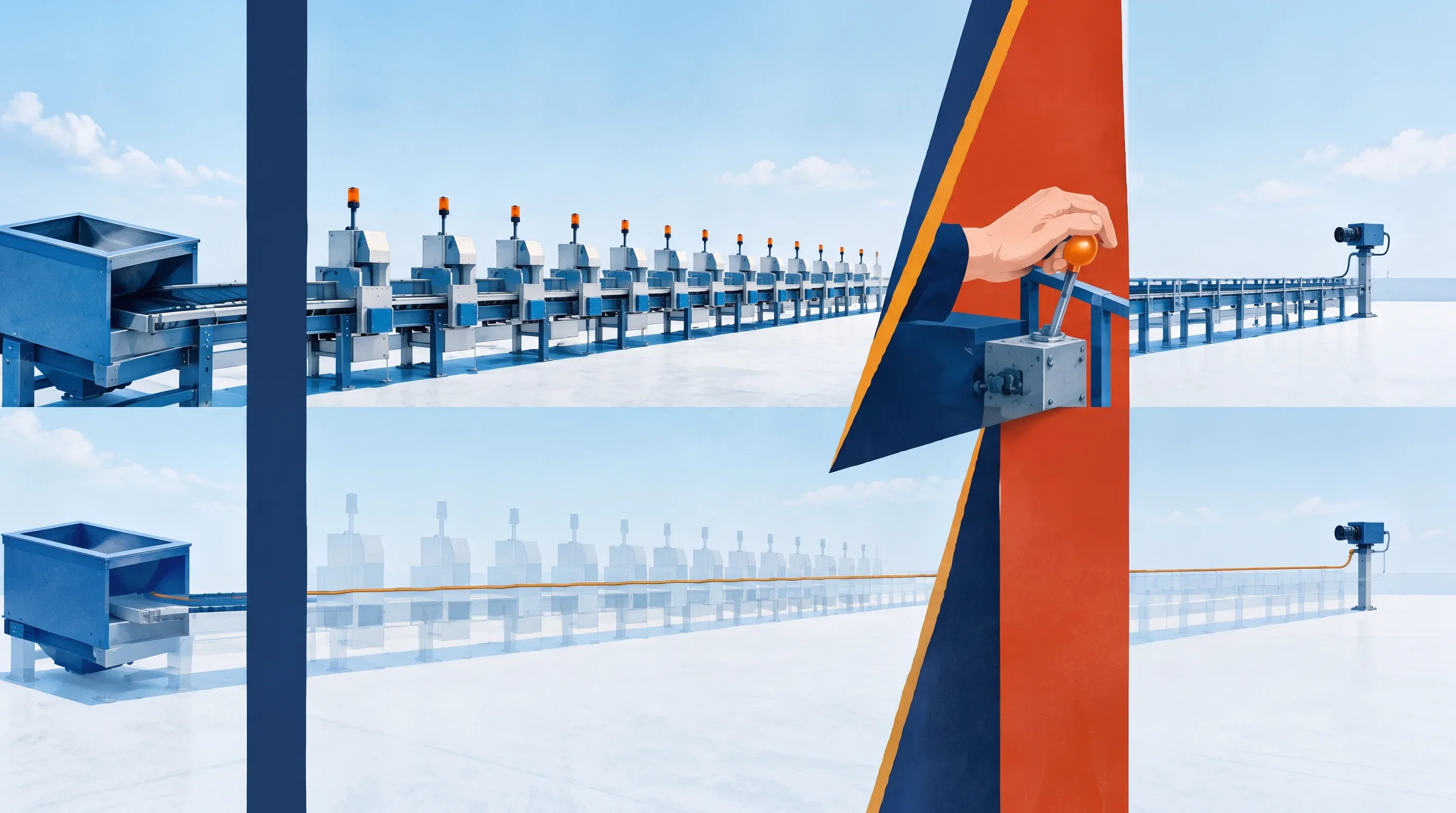
AI video arrived, every brand tried it in the same quarter their competitors did, and the feeds filled with clips that are technically impressive and completely interchangeable. Smooth motion, plausible people, nice light. Nothing that tells you whose ad it is. On our own product page we call this what it looks like: AI video turned every feed beige.
If you run a consumer brand, you've probably felt the specific disappointment of this. You typed a good prompt. The clip came back competent. And it could have been made by any of the forty brands in your category, because in a real sense it was — the model gave you the average of everything it has seen, which is exactly what you'd expect from a machine that was asked to start at the end.
That last phrase is the diagnosis, and it deserves a slower look.
Video was never made at the camera
Think about how brand video got made before any of this. No agency worth its fee started by shooting. Somebody studied the brand. Somebody studied what was working in the category. A creative team generated ideas, most of which died in the room. Scripts got written and rewritten. Legal looked at the claims. Casting happened. And then, at the end of a process that consumed most of the budget and almost all of the judgment, a camera rolled.
The render — the shoot — was the last thing that happened. Everything distinctive about the output was decided before it.
What the first wave of AI video tools actually did was delete every stage except the last one. The prompt box replaced the research, the strategy, the scoring, the compliance review, and the casting, and the model was left to fill all of those roles implicitly, from its training average. The beige isn't a quality problem, and it won't be fixed by better models rendering prettier frames.
The beige is what the missing stages look like on screen.
So the useful question about any AI video system, ours included, is never "how good does it look?" It's "what happens before the render?"
What the stages look like when you rebuild them
At Jinn we built our video product, Silver, as that full process rather than a prompt box. I'm walking through its stages here because they're a usable checklist whether or not you ever touch our version: this is the pre-render work, made explicit.
Study the brand before the category.
Study the category with receipts, not vibes.
Turn the research into directions before asking for a single line. Generate wide, score hard.
Check the claims before the frames.
Lay out the shots before anything is shot. Only then, render — and judge the render.
Silver starts by reading the brand the way a new hire would — voice, product, positioning. In our build, more than fifty Brand DNA signals and forty-five product fields feed the video work before anything is written. The counts matter less than the posture: the system's first job is learning who is speaking.
What you hand it is your URL. No brief, no deck, no shot list. Everything else comes from the brand record every Jinn product reads, the one structured from your own site and evidence; Silver reads that record rather than inventing one. And different parts of it go to different stages: voice signals steer the scripts, guardrail and claim signals feed the compliance checks, visual and wardrobe signals dress whoever is on screen, and the product fields keep the label and the ingredients honest. A prompt box gets none of this, which is why it has to guess.
Then it researches what's actually working in the category, pattern-matching against a library of more than a hundred thousand analyzed real video ads, each broken down across five layers. What hooks people. What visual beats land. What falls flat. A human strategist does this with twenty tabs open and calls it taste; the honest machine version is the same judgment run across a library too large for tabs.
The five layers are the ones a strategist would run by hand if they had the weeks. Performance: views, shares, how far it traveled. Caption and transcript: the hook, the angle, the tone, and the claims that carry risk. Comments: the objections people raised, the intent they showed, the words they used. Vision: what the frames actually did, the visual hook, the proof shown, the archetype, the call to action. And pattern clustering across all of it, so what emerges is a beat structure that has already landed in your category rather than one that sounded good in a prompt.
Between research and hooks sits a stage most people skip: the brief. Silver writes ideation briefs, each a distinct direction with a pain point, a tribe, and a visual direction named, and each stored with the inputs that produced it. On the example run we publish on our product page, one brief is titled "Soda Nostalgia Without the Guilt," tagged for a nostalgia play, wellness millennials, and TikTok. That's a strategy, not a prompt. It names who the ad is for and what it should make them feel before anybody writes the first word. Hooks generated without a brief are hooks generated for nobody in particular, and nobody in particular is exactly who the beige is for.
Creative briefs become a slate of twenty-four hooks, each scored on five criteria: strength, clarity, brand fit, novelty, platform fit. Only the strongest advance to full scripts, and scripts come back ranked with the reasoning attached, not a black box handing you its favorite. Most ideas are supposed to die before production.
A tool that renders your first idea is skipping the stage where quality happens, whatever time it seems to save.
The scoring is where the difference becomes visible. On that same example run, the top hook came back as a line of dialogue: "This tastes exactly like the cola I grew up drinking. But it's actually good for my gut?" We show it on the product page next to what a general model produces for the same brief with no brand record behind it: "Introducing the better-for-you soda everyone is talking about."
| The example run, with the brand record | A general model, no brand record | |
|---|---|---|
| The top hook for the same brief | This tastes exactly like the cola I grew up drinking. But it's actually good for my gut? | Introducing the better-for-you soda everyone is talking about. |
The second line is the beige. It's grammatical, it's on topic, and it could open the ad for any drink in the aisle. Of the first line's five scores, the highest was brand fit, and you can see why without being told: it's a specific person with a specific memory and a specific doubt. From there, several writing passes take a run at each approved hook, and the ranking that comes back reads like a strategist's margin note (strongest hook, nostalgia play, highest platform fit) rather than a number you take on faith.
Every surviving script passes a compliance review (regulatory audit, brand guardrails and voice, platform ad policy) and then stops at a human sign-off. (That gate deserves its own essay, and it has one on this shelf.) Order matters inside this stage too. A production house does its legal review at the end, where changes are most expensive; Silver runs the four checks before production, and a script that fails one is rewritten and checked again rather than thrown out. The regulatory read goes first, ahead of brand and platform, so a claim you can't make is caught at the top of the funnel instead of after a render.
The chosen script becomes a shot-by-shot storyboard with the character and product references pinned to it. A storyboard row reads the way a shot list always has: the first three seconds are a close-up, a phone screen in morning light, the presenter glancing up; the next five pull back to a medium shot, speaking straight to lens; then an over-the-shoulder cut to the product in use. Which shots show the product, and which don't, is decided here, on paper, where changing your mind is free.
The last stage is the one the prompt-box tools start with. Even there, the design puts an AI reviewer on each finished clip, and weak takes get remade rather than sent out. And because the storyboard already decided which shots show the product, the render stage is designed to put the product reference only into those shots, so it doesn't bleed into frames it has no business in, and to produce the sequence as one coherent whole rather than stitching separate clips together and hoping the cuts match. Neither of those is a rendering decision. They're upstream decisions the render obeys.
Every stage leaves a receipt
The objection I'd raise to all of this, reading it from the outside, is that a longer process is just a longer black box. It would be, if the stages were opaque. They aren't. Every brief is stored with the inputs that produced it, and the instructions that drive each stage are kept as numbered versions rather than baked in, so when a script exists you can trace it back through the brief, the hooks, and the research that made it. Traceability is a property of how the thing is built, not a promise in a deck. That's the practical difference between a process and a prompt: a process can be audited at the stage where it went wrong. A prompt can only be tried again.
The checklist survives without the software
This part you can use with whatever tools you already have.
Before you commission AI video from anyone (a vendor, a freelancer, an internal team with a subscription), do the deleted stages by hand, in order.
Write one page on the brand: voice, the three claims you can prove, what the product actually does for the buyer.
Pull twenty real ads from your category and write down each one's hook and why it holds or loses you.
Generate hooks in quantity, then score them against named criteria before anything advances; the scoring criteria force the argument into the open.
Have someone who didn't write the script check its claims against what you can substantiate.
Then, and only then, spend render money.
And if you're evaluating vendors, you now have the only question that separates the category: ask them what happens before the render.
A real answer names stages, shows you scores, and tells you where a human decides. A vague answer means the prompt box is the whole product, and the beige is included at no extra charge. Our own comparison page puts the prompt-box answer in three words: "Type, generate, hope." And its quality-control plan in five: you are the QA department.
The models will keep getting better, and the clips will keep getting smoother, and none of that will make your video yours. The render is the last thing that happens. That's not a limitation of the good systems. It's the trick: the research, the hook, the script, and the compliance pass are all done before a single frame renders.
Silver is in private beta. The research, hook, script, and compliance stages run today; the render stage and its judge are built and not yet live. Self-serve access isn't open, and nothing on our pages is a customer's work.
See what happens before the render
See how Silver worksWill better models fix the sameness?
The beige isn't a quality problem, and it won't be fixed by better models rendering prettier frames. The models will keep getting better, and the clips will keep getting smoother, and none of that will make your video yours.
What do you have to provide?
What you hand it is your URL. No brief, no deck, no shot list. Everything else comes from the brand record every Jinn product reads, the one structured from your own site and evidence.
Why run the claim checks before production rather than after?
A production house does its legal review at the end, where changes are most expensive; Silver runs the four checks before production, and a script that fails one is rewritten and checked again rather than thrown out. The regulatory read goes first, ahead of brand and platform, so a claim you can't make is caught at the top of the funnel instead of after a render.
How do you tell a real process from a prompt box?
Ask them what happens before the render. A real answer names stages, shows you scores, and tells you where a human decides. A vague answer means you're buying a prompt box with the stages missing, and the beige is included at no extra charge.