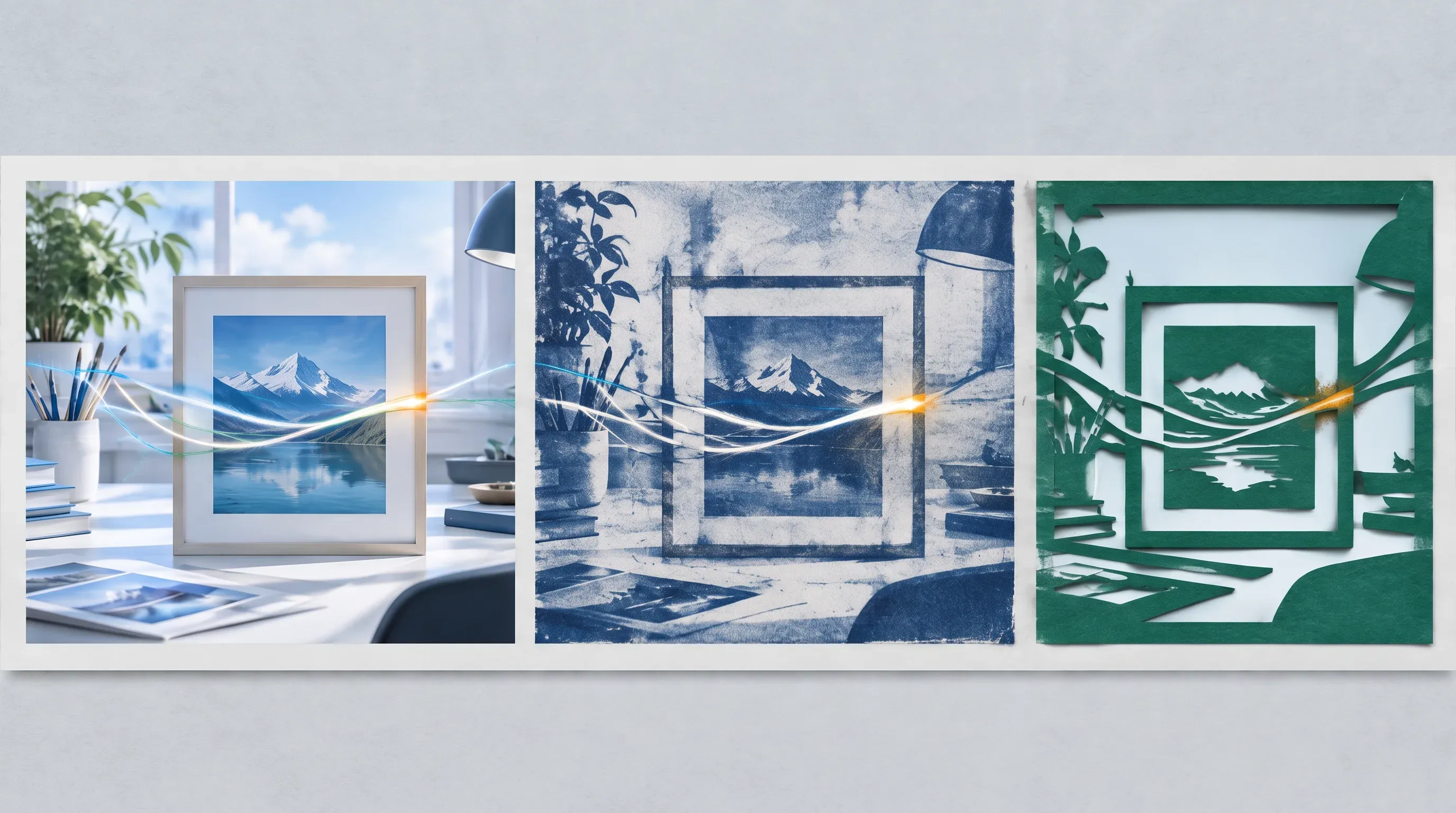
The label is wrong. In my experience that's how a lot of shoots end, and it never ends on shoot day. It ends on review day, weeks after the brief, when someone zooms into the hero frame and the flavor line reads a shade off, or the bottle is last season's shape, or the pack in the photographer's hand carries a claim the brand had already pulled. At that point the honest math is another shoot day. Booking, crew, retouch, review, again. The photographer isn't wrong to charge for it. It's a second shoot.
I've paid for creative at every brand I've run, and the shape has been the same each time: weeks of planning and shooting and editing, thousands or tens of thousands of dollars, for a set of frames that had to be right the first time because a second time cost the same again.
Vermeer is the studio we built so a brand doesn't have to make that trade. One studio, every shot your brand needs: product photography, ads, and organic content, painted from your Brand DNA, reference-driven, product-true, and directed in a conversation. One frame or a whole campaign. It still misses sometimes, and I'll say where. This piece is what that means in practice.
It starts from your product
Every AI image tool can make something pretty. The reason most of them can't make something a brand can ship is that they start from a prompt, and a prompt doesn't know what your product looks like. Vermeer starts from a reference ad that already worked. It adds your true product, cut out of your own photo, and it adds your brand record, all 346 signals of it, and the three meet before a single pixel renders.
The reference goes in first. Point the studio at an ad that performed and a vision model reads it into a reusable creative brief: the hook, the psychology it pulls, the composition, the shape of the copy. The source brand, product, and claims are stripped at analysis, so what you keep is the structure that worked and none of the content that was theirs. The case for why that's the only honest way to use a swipe file, and the tour of each format's load-bearing parts, are pieces of their own; the studio is those two ideas running as a machine.
Then your product. Your real product photo becomes a clean cutout, cached for reuse, before any paid render fires. Confidence is measured. A doubtful cutout falls back to your original photo instead of feeding a broken subject to a render you'd be paying for.
Then the record. Vermeer reads the same 346-signal Brand DNA record every Jinn product reads, and paints from the signals that matter inside a frame: palette, product truth, verified claims, voice. The scene is generated around the true product with only the claims your record can back. A missing proof point never becomes a made-up one. If there's no review count to cite, the hook is expressed without inventing one, and that rule lives in the generation itself, not in a cleanup step afterward.
The order is deliberate. Reference, then product, then record, then paint, and the reason it runs in that order is money: a doubtful cutout or an unbackable claim gets caught before the render fires, while it's still free to fix.
Point the studio at an ad that performed and a vision model reads it into a reusable creative brief: the hook, the psychology it pulls, the composition, the shape of the copy. The source brand, product, and claims are stripped at analysis.
Your real product photo becomes a clean cutout, cached for reuse, before any paid render fires. A doubtful cutout falls back to your original photo instead of feeding a broken subject to a render you'd be paying for.
Vermeer reads the same 346-signal Brand DNA record every Jinn product reads, and paints from the signals that matter inside a frame: palette, product truth, verified claims, voice.
A missing proof point never becomes a made-up one.
Six working surfaces
Underneath the paint are six surfaces, and each is a real part of the studio.
New Shoot is the front door. Briefing is a conversation, not a form. You tell Vermeer what you're launching and what it needs to feel like, and it turns that into a shoot plan with slots, formats, and cast. Quick Shot runs one frame when you need a single hero image or a one-off ad. A Campaign runs the full set. The same thread that briefed the shoot keeps directing it afterward, so you shape product, scene, mood, lighting, and ratio in plain words, tighten a scene, swap an angle.
Seven dials make up Visual Style, seeded from your record and yours to turn: medium, grade, finish, lens, time, lighting, mood. Confirm the seed, override it, or clear it. An empty slot means clean photoreal. There is no hidden default sitting under an empty slot.
Two-axis QA grades every composite twice. The first axis is mechanical, a pixel-contrast check with no judgment call in it, measuring whether the copy is actually legible. The second is a vision judge, which asks whether the product was distorted and whether text landed over a face or over the product. The judge works from a short list of named failures, and the list is worth reading because it's the list a brand actually cares about: wrong product, distorted product, text over a face, text over the product, illegible text, a scene artifact, a competitor's brand leaking into the frame. Both axes surface what they find beside the frame, for your review. A Quick Shot you don't love re-rolls as a fresh frame from the same brief, a new shot with its own run, never a mutation of the one you already looked at.
Underneath all of it sits the Ad intelligence library, the swipe file. A corpus of reference ads, ingested, ranked, tagged, de-duplicated, that the studio draws creative structure from. It's where the Ad formats come from: proven shapes, never somebody else's brand.
The Shoot Library keeps every run, browsable and reusable, so yesterday's campaign is tomorrow's reference. Finished ad sets export as a downloadable package, including a Pinterest-format bulk-upload file with the schedule spread and the column mapping done. You run the upload yourself. There's no live push to Pinterest, and we say so.
Casting is the one I'd underline. A Character Capsule is a recurring human your brand keeps: cast once, and the same face carries across every shot and every campaign after it, which is the thing a photographer could only promise if the same model was free on the same day.
A campaign, not a lottery ticket
Most AI imagery arrives as one-offs that happen to share a logo. A Campaign in Vermeer is a goal-driven set of shots compiled as one shoot: same product, same light, same world, different moments. Six goal types cover the calendar. A product launch. A promo or sale. A new channel. A seasonal push. Evergreen catalog work. A weekly organic feed, if you want a feed and not just a launch. Each goal carries its own emotional register and its own default roster of slots, and the whole set lands as a draft you review before anything is finalized. The judge advises. You decide.
The judge advises. You decide.
Where it still gets it wrong
Early AI creative got things wrong that a photographer never would. Garbled text on the label. The wrong color. The wrong shape. That's largely gone now, and it still sometimes happens with Jinn. I'd rather say that here than have you find it in a frame, because it's the reason the checks sit throughout the pipeline: visual verification and accuracy checks at every stage, so that what's delivered is on brand and not just pretty.
The structural difference is that Vermeer isn't building from a single image or a single prompt. The brand DNA context rides along inside the same pipeline, so the environment, the scene, and the copy come out closer to the brand with less human correction than a prompt-and-hope tool gives you. Closer, and graded. On ads the grading is advisory: findings surface with the frame and a human signs off, always. Product shoots go one step further. Arm accuracy lock and every frame is scored against your real product photos; a frame under your floor re-rolls automatically, fresh attempts, best frame wins. You arm it, and nothing about it is silent.
You arm it, and nothing about it is silent.
That advisory posture has a cost and I'll name it. A human sign-off on every set is slower than a tool that ships volume and lets you spot the misses at review. We chose slower, and the reason is what one wrong frame does across a brand's channels. 54 percent of shoppers say they have abandoned a sale because the product content wasn't consistent from one channel to the next (Salsify, 2025 Consumer Research, published January 2025; a survey of 1,910 US and UK online shoppers fielded in October 2024). A shopper doesn't grade a frame on its own. They see the ad, then the listing, then the product page, and the bottle that changed shape between two of them is the inconsistency they walk away from. That's the case for one studio rather than a different tool for every channel: the ad, the listing, and the product page are painted from the same record and the same true product, so they agree with each other before a shopper compares them. Everyone can generate and nobody can prove; I've made that case elsewhere, and a judge reading every composite before you do is the proving part, built into the studio.
Against the way you make ads today
The honest comparison for Vermeer isn't another tool. For a brand, it's the photographer, the retainer, and the three-week turnaround. For an agency, it's the production you outsource per client, which means the shoot day, then the retouching pass, then the reshoot when the label is wrong.
A new campaign takes weeks that way, in booking, shoot day, retouch, and review. In the studio it takes a brief and a review pass. A reshoot costs another shoot day; here it costs credits for the frames you re-fire, and a re-fire is a fresh frame from the same axes, so you keep the one you liked. Product accuracy, which used to be the photographer's eye, is measured on every composite with the findings surfaced. And the off-season, which I lived at a seasonal brand and wrote about in the founder piece, is the row I'd read twice: the retainer keeps billing through the quiet months, and credits wait.
| The way you make ads today | In the studio | |
|---|---|---|
| A new campaign | Weeks, in booking, shoot day, retouch, and review. | A brief and a review pass. |
| A reshoot | Another shoot day. | Credits for the frames you re-fire, and a re-fire is a fresh frame from the same axes, so you keep the one you liked. |
| Product accuracy | The photographer's eye. | Measured on every composite, with the findings surfaced. |
| The off-season | The retainer keeps billing through the quiet months. | Credits wait. |
I don't read any of that as an argument against the creative people I work with. Vermeer is a prototyping tool for creative teams, a way to articulate a vision, test it, and iterate at the speed of the idea, and a smaller team gets to test in ways that used to take significantly more budget and patience than it had. The review day I opened with still happens. It just happens before anything is paid for, when a wrong label costs a sentence in the conversation instead of a second shoot.
Vermeer is invite-first.
See how the studio works
Reference, product, record, paint: the order the studio runs in, and why it runs in that order.
How Vermeer worksDoes Vermeer publish to Pinterest for me?
No. Finished ad sets export as a downloadable package, including a Pinterest-format bulk-upload file with the schedule spread and the column mapping done. You run the upload yourself. There's no live push to Pinterest, and we say so.
What happens if I don't like a frame?
A Quick Shot you don't love re-rolls as a fresh frame from the same brief, a new shot with its own run, never a mutation of the one you already looked at.
Does the QA judge block a frame on its own?
On ads the grading is advisory: findings surface with the frame and a human signs off, always. Product shoots go one step further. Arm accuracy lock and every frame is scored against your real product photos; a frame under your floor re-rolls automatically, fresh attempts, best frame wins.